
Quick summary History shows that investors who stay disciplined and resist the urge to react to headlines build significantly more wealth than those who panic. The lesson for professionals, business owners and retirees is clear: stand at a distance, stick to the plan and let time do the heavy lifting.
What’s happening in the Middle East is unsettling. And, we’re all feeling the impact at the petrol pump.
Understandably, a lot of good people are spooked.
So a fair question is: should you be worried about your investments?
The answer is nearly 150 years old.
The 150-Year-Old Sage Advice
Back in 1881, a piece of investment advice was doing the rounds on Wall Street. It wasn’t about what to buy or when to sell.
“To see and comprehend the market, you must always stand off at a distance.”
The reasoning was that the constant talk of nearby speculators would drive you into a “state of semi-insanity, where you, in all probability, will do something you’d regret almost immediately.
The only cure was to physically remove yourself from the crowd to escape the noise.
In 1881, the “noise” was the physical trading floor. Today, it’s 24/7 news cycles, social media hot takes, your uncle’s barbecue commentary, and HS Tikky Tokky from the manosphere with qualifications from the back of a Weet-Bix box telling you what shares to buy.
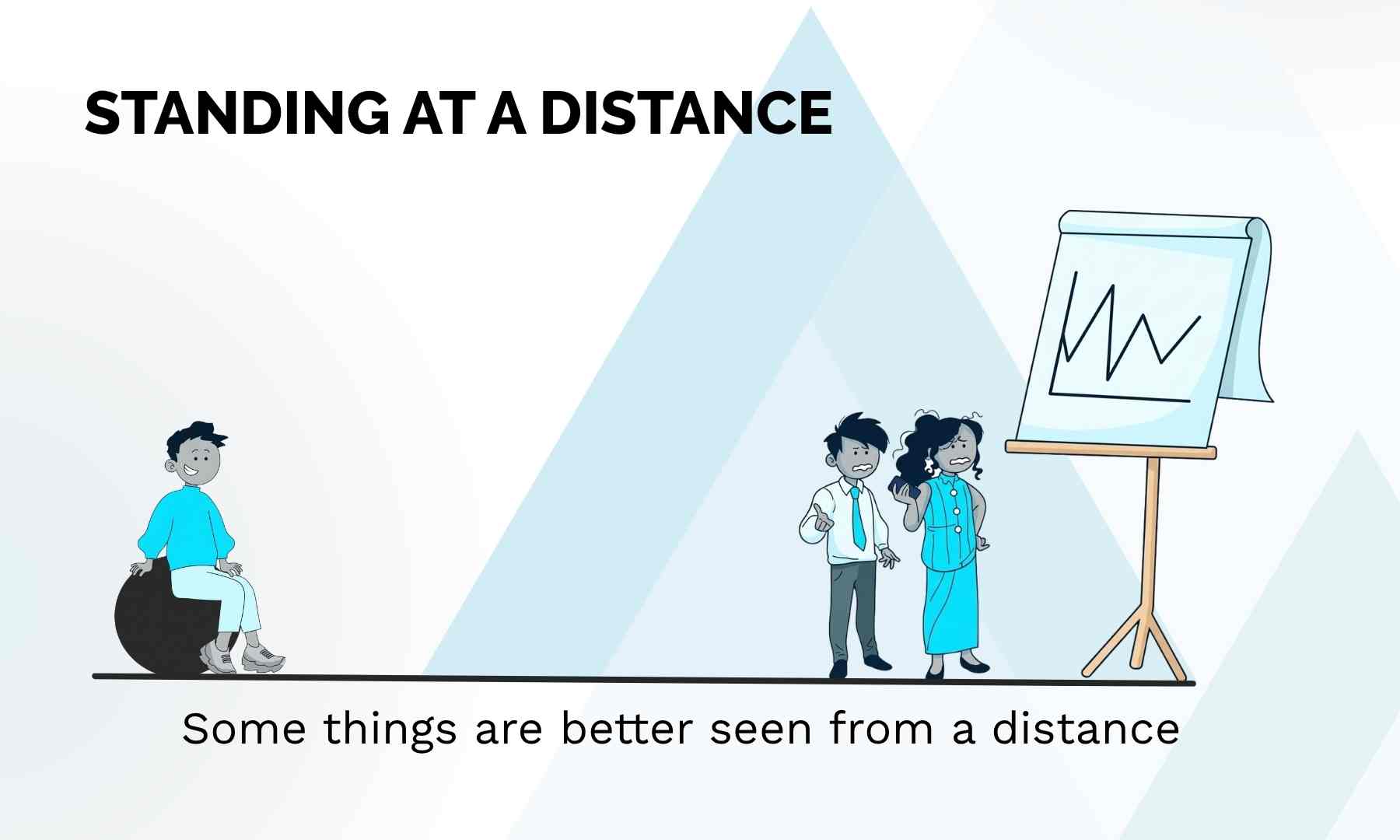
Why Getting Too Close Leads to Fuzzy Decisions
It’s like zooming right in on a photo on your phone. All you see are grainy pixels. Nothing makes sense. But pinch out to the full image and the picture is clear.
Your portfolio is the same. And the research backs this up. Investors who check their balances daily are basically zooming in on pixels. They trade more often, overreact to losses and perform worse over time than people who maintain a healthy distance.
Because when they’re zoomed in, they’re not thinking about the full picture. They react out of fear.
What $100 Tells Us About Zooming Out
Based on 60 years of data, if you’d invested $100 in 1965 across different asset classes, here’s where you’d be today:
- Cash (3-month US Treasury bills): $1,500
- Stocks (S&P 500, dividends reinvested): $43,000 (that’s 435 times your money)
- Gold: $12,000
- Corporate Bonds: $9,200
- Government Bonds: $2,800
- Real Estate (Case-Shiller, price only): $2,100
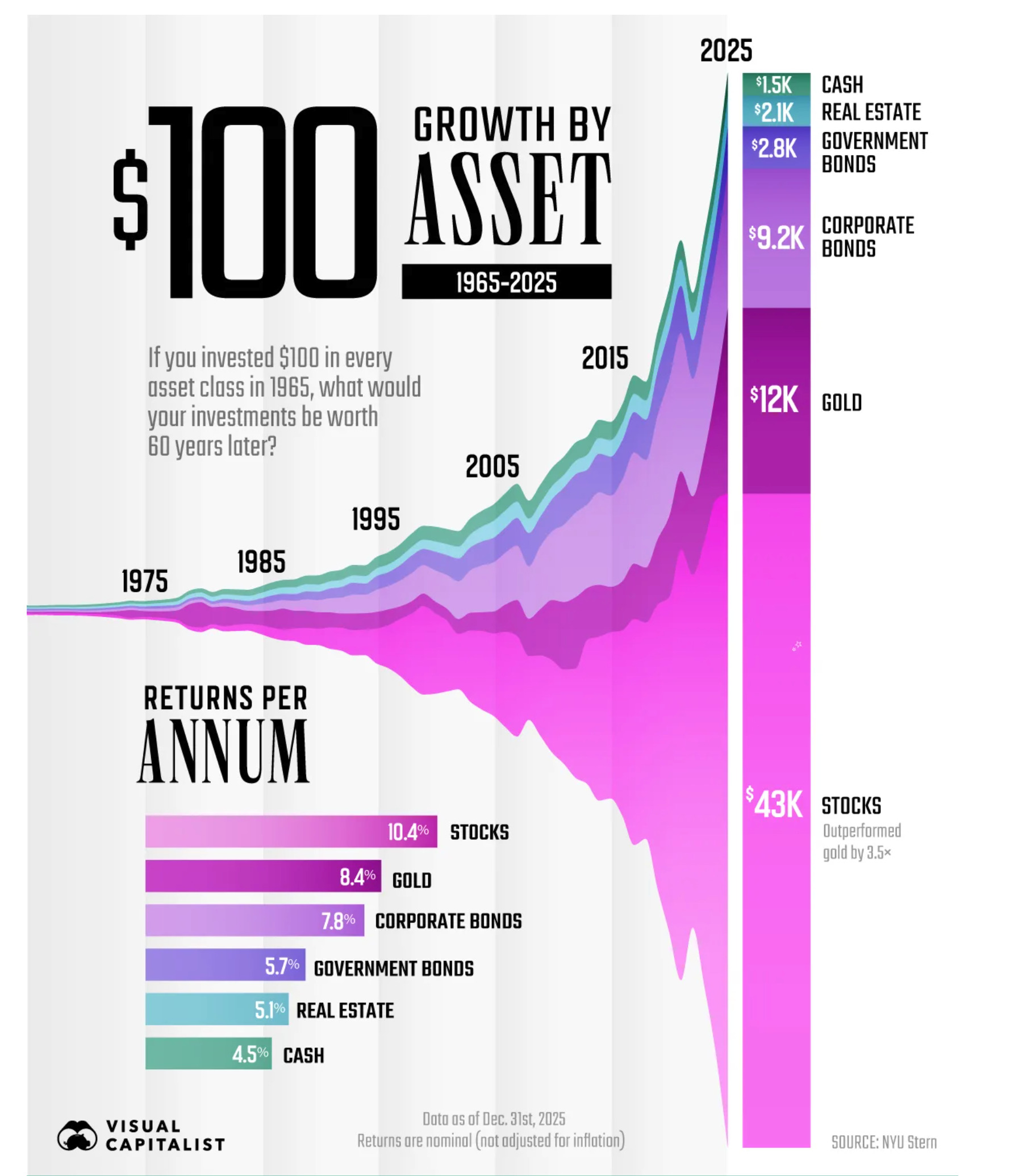
Stocks outperformed gold by 3.5 times. They outperformed cash by almost 29 times.
That 60-year period included the Vietnam War, the 1987 crash, the dot-com bubble, September 11, the GFC, COVID and every other crisis that felt like the sky was falling at the time.
The people who panicked and sold missed the recovery. The people who stood at a distance and stayed invested? They turned $100 into $43,000.
I wrote about this last year when Trump’s tariff tantrums sent my inbox into meltdown.
The lesson then is the same lesson now: form is temporary, class is permanent. Quality assets bounce back. (Read that blog here)
What’s Actually Happening Right Now (March 2026)
Let’s not pretend everything is sunshine and lollipops. The RBA has hiked rates twice in a row. Oil prices are through the roof. Markets have dropped. And the nightly news is doing what it does best: making everything feel like the sky is falling.
Scary headlines when you zoom in. But look at the 30-year numbers on this chart.
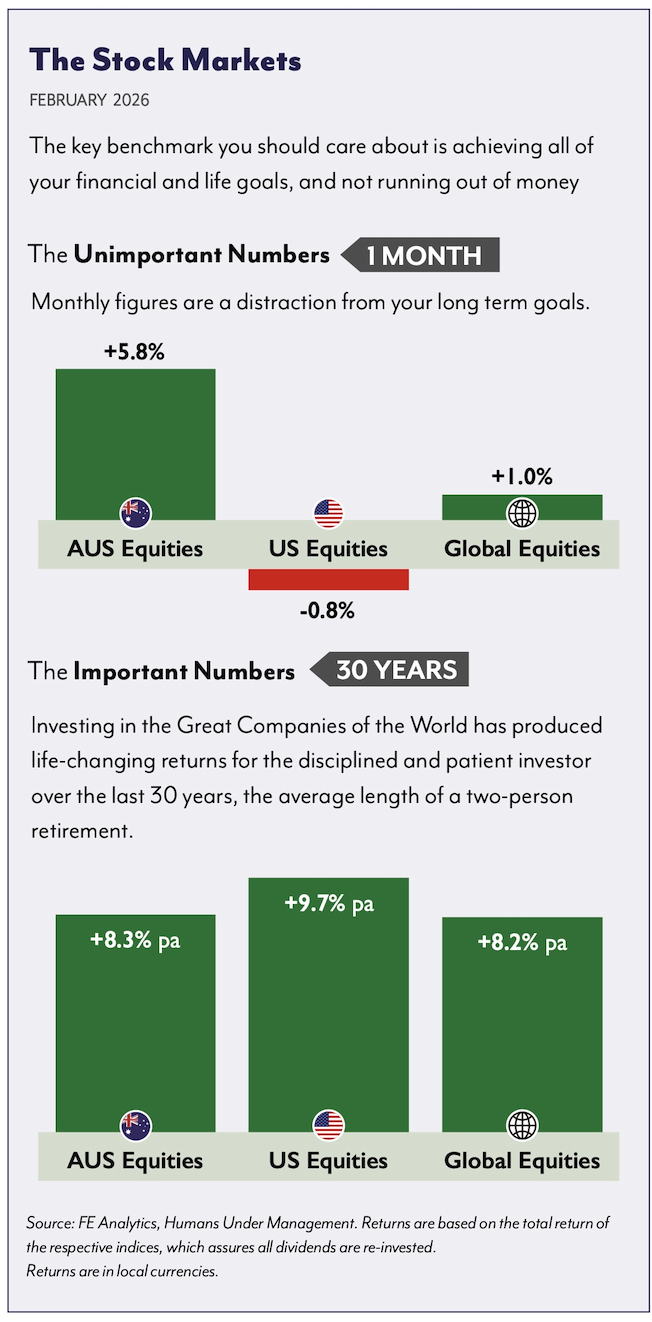
The one-month numbers are what we call the unimportant numbers. They’re a distraction from your long-term goals.
The benchmark you should care about is achieving all of your financial and life goals and not running out of money. Full stop.
How to Create Distance From the Noise
Standing at a distance used to mean physically walking away from the trading floor. In 2026, with market apps on your phone and news alerts pinging every five minutes, it takes something more deliberate.
1. Check your portfolio quarterly, not daily
Delete the app that shows market movements. Seriously. A 20-year plan doesn’t need daily scorekeeping. The less frequently you measure results, the more clearly you see the trajectory that actually matters.
2. Turn off the financial noise
Sky News isn’t your financial adviser. Neither is that bloke at the pub. If the source of your financial information doesn’t know your name, your mortgage balance and your retirement goals, their opinion is just noise.
3. Focus on the assets you own
When markets fall, remind yourself what’s in your portfolio. If you’re an Apex client you’re invested in real businesses that make real money every single day. Apple. Microsoft. Commonwealth Bank. Coles. Woolworths. BHP. People are still buying iPhones, doing their groceries and taking out home loans. The value remains, even when the share price takes a temporary hit.
4. Remember your timeframe
If you’re a 40-something professional or business owner planning to retire at 60, you’ve got 20 years. That’s a lot of runway.
And if you’re in your 50s or nearing retirement, this is when having the right structure and strategy matters most. A good plan means you’re never in a position where you’re forced to sell when markets are down. Your cash flow is sorted, your short-term needs are covered, and your investments have the breathing room to recover without you losing sleep.
5. Be opportunistic, not reactive
Here’s what I’ve been saying to clients: for retirees, we’re holding their hands and helping them resist the urge to go to cash. For the younger professionals and business owners, we’re actually increasing exposure while markets are at multi-month lows.
We’re not speculating on rubbish assets. We’re investing in quality companies. Temporary declines are never permanent when you own quality.
The Real Advantage: Staying Calm When Everyone Else Is Buying a 5-Year Supply of Toilet Paper
That old 1881 advice finished by recommending that investors act with patience, discipline and thoughtful composure.
This 150-year-old advice holds up: stand at a distance, stay disciplined and let quality do the work.
Stuff happens. It’s been happening for 150 years. Wars, pandemics, financial crises, political chaos. And through all of it, quality assets have continued to climb higher.
The market rewards patience, not predictions. Invest consistently, ignore the noise and let time work its magic.
Stay Beautiful!
John Manserra Certified Financial Planner®, Director
Apex Advice – Geelong Financial Advisers and Geelong Mortgage Brokers for business owners and professionals who want to make work a choice before you’re 67. Book a 15 minute chat here.
👉For more of the good stuff you need to know to organise, grow and spend your money with confidence, subscribe to The Stash newsletter.
👉Download our Money Flow Playbook for a practical framework to make money progress.
Important:
This is not tax advice. The information contained in this update has been provided as general advice only. The contents have been prepared without taking account of your personal objectives, financial situation or needs.
You should seek advice before making any decision regarding any information, strategies or products mentioned to consider whether that is appropriate to your own objectives, financial situation and needs.
Current at 27 March 2026
The information contained on this website has been provided as general advice only. The contents have been prepared without taking account of your personal objectives, financial situation or needs. You should, before you make any decision regarding any information, strategies or products mentioned on this website, consult your own financial advisor to consider whether that is appropriate having regard to your own objective, financial situation and needs. Apex Advice Pty Ltd ABN 14 655 779 187 is a Corporate Authorised Representative (ASIC 1296045) of Paragem Pty Ltd ABN 16 108 571 875 Australian Financial Services Licence 297276. Australian Credit Licence 389087.
W: paragem.com.au T: (02) 8036 6490
Built by Simply Advice Websites with Brand, Design, and Messaging by Brandover